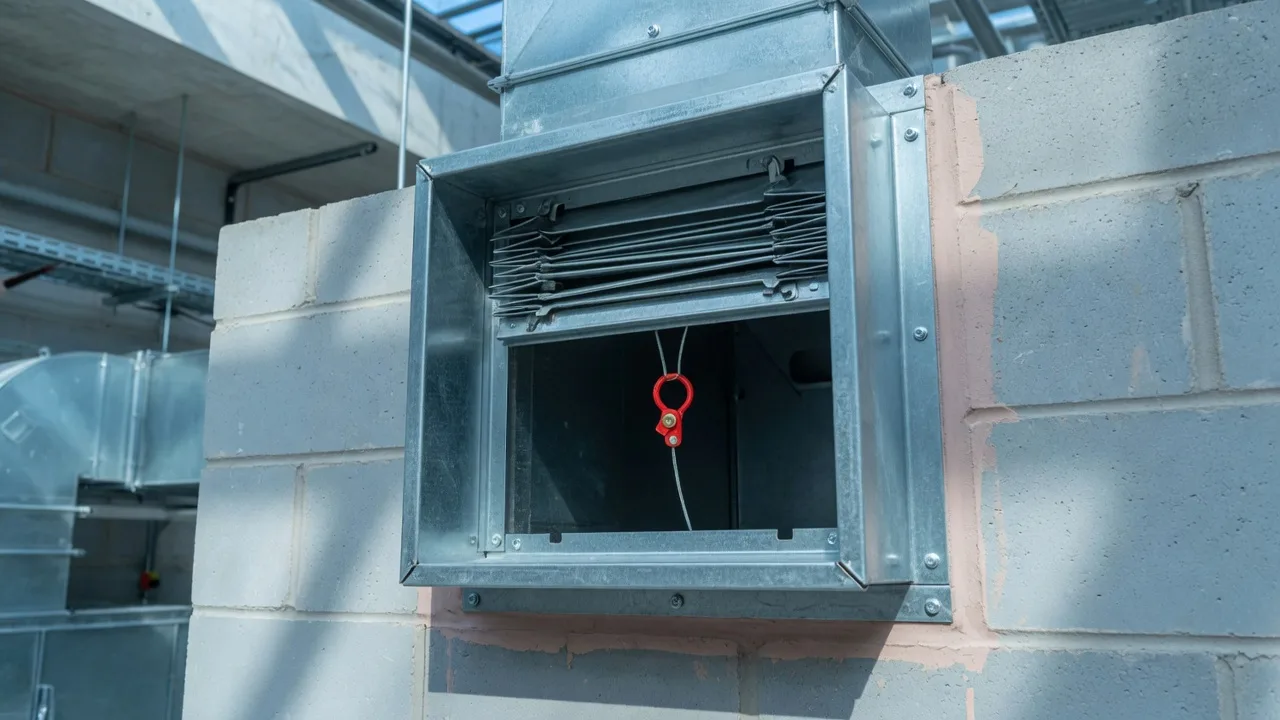
Fire dampers sit hidden inside your building’s ventilation and ductwork, yet they are a life-safety device that keeps a fire contained. This guide explains what fire dampers are, how they work and the critical role they play in protecting the people and property inside your building.
Understanding fire dampers
What are fire dampers?
Fire dampers are safety devices installed within building ventilation and ductwork systems to prevent fire and smoke spreading through heating, ventilation and air conditioning (HVAC) systems. Their purpose is to contain a fire within the compartment where it starts, protecting occupants and limiting damage while the fire service brings it under control.
Ductwork routinely passes through fire-rated walls and floors. Fire dampers sit at these penetration points and close automatically when a fire is detected, stopping flames and smoke travelling from room to room or floor to floor through the ducts. Without them, concealed spaces such as ductwork, wall cavities and ceiling voids would let fire and smoke move freely through a building.
Fire dampers are classified by their design (static or dynamic) and by where they are installed, such as within one-hour fire-rated walls or in exhaust ductwork. Understanding these classifications helps you specify the right device for each part of your system.
You will see a few related terms used across specifications and fire strategies, and it pays to know the difference. Fire dampers stop the spread of flame. Smoke dampers control the movement of smoke. Actuated fire dampers are motorised units that can be shut automatically by the fire detection system or manually from a control position, cutting off airflow through the duct the moment a fire is detected. Whatever the label on the drawing, these devices are your first line of defence inside the ventilation system, and each one needs to be identified, tested and recorded in its own right.
Types of fire dampers
Static and dynamic fire dampers. Static fire dampers stay closed during a fire without needing power or active control. They usually operate on a fusible link that melts at a set temperature, releasing the damper to close. Dynamic fire dampers use actuators and can be controlled automatically or remotely, allowing them to integrate with a building management system for more precise operation.
Fire and smoke dampers. Fire dampers are designed mainly to stop the spread of flame. Smoke dampers control the movement of smoke through the building. Combined fire and smoke dampers carry out both functions and are common in critical areas such as ventilation and exhaust ductwork, where smoke control is essential to keep escape routes clear.
Materials and construction. Fire dampers are made from durable materials such as galvanised or stainless steel so they can withstand the high temperatures of a fire. The fusible link is a key component, typically melting at around 72°C to trigger the damper. Correct material selection keeps the damper intact during a fire, particularly in demanding locations such as one-hour fire-rated walls.
How fire dampers work
Activation during a fire. Most fire dampers are triggered by a fusible link or heat sensor. When the surrounding temperature rises, the link melts and releases a spring-loaded mechanism that drops the damper blade, sealing off the duct. Actuated fire dampers in HVAC systems instead use electric or pneumatic actuators driven by the fire detection system.
Heat detection and fusible links. Fusible links respond quickly to heat, giving rapid activation when it matters. In many buildings, fire dampers are tied into smoke detectors or heat sensors for an additional layer of protection, closing automatically to contain both fire and smoke.
Integration with HVAC and building management systems. Modern fire dampers are often connected to building automation systems so their response is coordinated during an emergency. That integration shuts down air handling promptly, preventing the ventilation system from feeding a fire or carrying smoke into occupied areas. It also supports the building’s wider smoke control strategy, working alongside systems such as active heat recovery rather than against them.
The critical role of fire dampers in building safety and fire prevention
Fire containment and smoke control
Fire dampers are central to stopping flames and smoke spreading through ductwork and concealed spaces. By sealing fire compartments, they hold a fire within a defined area and reduce the risk of it escalating across the building. This compartmentalisation protects escape routes, critical infrastructure and building contents.
Fire dampers in exhaust ductwork are particularly important for smoke control, keeping smoke out of escape routes and other vital areas. Smoke, not flame, accounts for most casualties in a building fire, so dampers that close reliably make a direct difference to occupant safety. They perform best as part of a layered strategy, combined with smoke dampers and coordinated with the rest of the ventilation system, rather than treated as isolated devices.
Regulatory standards and compliance
Fire safety regulations require fire dampers wherever ductwork penetrates fire compartments, including one-hour fire-rated walls. In the UK, fire damper testing and maintenance is governed by BS 9999, the code of practice for fire safety in the design, management and use of buildings, which calls for spring-operated fire dampers to be tested at least annually, and more often in dust-laden environments. Product performance is also verified against international certification standards such as UL and FM.
Testing at regular intervals supports your duties under the Regulatory Reform (Fire Safety) Order 2005. The responsible person for the premises must make sure fire dampers are inspected, tested and recorded so they will perform when needed. Falling short of the standards works both ways: it compromises the safety of everyone in the building, and it can leave the responsible person exposed to legal liability if a fire spreads through a damper that was never tested.
The benefits of properly installed and maintained fire dampers
When fire dampers are correctly installed and maintained, the payoff is direct. They significantly reduce property damage and the risk of loss of life. They minimise fire spread, so a small incident stays a small incident. They keep evacuation routes usable while people get out. And they support the overall fire safety strategy of the building rather than sitting apart from it, closing off the one route through your compartmentation that walls and doors cannot cover.
None of those benefits survive neglect. Regular testing, inspection and maintenance are what keep a damper ready to close when it is needed, and a damper that fails on the day is worse than no damper at all, because everyone has assumed the compartment line holds.
Installation, maintenance and best practices for fire dampers
Correct installation
A fire damper only performs if it is installed correctly at the right point in the ductwork. Dampers must be fitted at every fire-compartment penetration, properly fixed within the wall or floor, and left with enough access for future inspection. Poorly positioned or inaccessible dampers are a common reason for failed inspections.
Good installation starts with a site assessment. The right damper for each opening depends on the building type, the configuration of the ductwork and the fire rating the wall or floor has to achieve, and the installation detail differs depending on whether the damper sits in an HVAC run, a wall or exhaust ductwork. The common pitfalls are consistent across buildings: dampers placed incorrectly, openings sealed inadequately around the sleeve, and manufacturer instructions not followed. Any one of these can stop an otherwise sound damper closing properly in a fire. Engage qualified professionals for the work and follow the guidance set by the Building Engineering Services Association (BESA).
Ongoing testing and maintenance
Fire dampers need routine testing to confirm they still close fully and reset correctly. Under BS 9999 this means annual testing as a minimum, with more frequent checks where ducts carry dust or grease. Where ductwork is cleaned as part of a ventilation hygiene regime to BESA TR19, damper testing sits naturally alongside that work.
Testing is more than dropping the blade. For actuated fire dampers, the test should confirm the unit responds correctly to a simulated activation from the detection system, not just that the blade moves by hand. For every type, the fusible link and the moving components should be inspected for signs of wear, damage and corrosion, and the damper reset and left in its correct operating position afterwards. The warning signs of a failing damper are easy to spot once you look: a blade that is stiff to open or close, visible corrosion, or physical damage to the frame, sleeve or link. Any of these calls for prompt repair or replacement, because a damper that cannot close is an open breach in your fire compartmentation.
Because dampers are built into the fabric of a building, they can be hard to locate and reach. Any damper left out of a testing regime, or never recorded in the first place, may fail to close in a fire. Clean Ducts is a BESCA Vent Hygiene Associate member and tests and reports on fire dampers in line with BS 9999, logging each damper as an individual asset that is labelled, photographed and condition-checked to give you a defensible compliance record.
Records, upgrades and regular upkeep
Keep detailed records of every inspection, test and repair. Those records are what demonstrate accountability and compliance if your fire risk assessment is ever challenged, and they build a maintenance history for each damper so recurring faults show up rather than being fixed and forgotten. Where a damper is outdated or repeatedly failing, upgrading or replacing it enhances the safety of the whole system, and this matters most in older buildings.
Our personnel are trained on proper handling and inspection procedures, so the support you get covers the practical side as well as the paperwork: locating dampers, testing them safely and keeping your records in order for your fire safety management team.
Essential components
Whatever the type, a fire damper relies on a few core components:
- The damper blade or curtain: interlocking steel blades that close to form a barrier inside the duct
- The fusible link or actuator: the trigger that releases the blade when a fire is detected
- The spring mechanism: drives the blade closed quickly and holds it shut
- The frame and sleeve: secures the damper within the fire-rated wall or floor
- Access provision: an access panel that allows the damper to be inspected and tested
When each of these is specified, installed and maintained correctly, the damper does its job: containing fire and smoke long enough for people to escape and for the fire service to respond.
Proactive measures, regular testing and adherence to the standards are what turn a set of hidden steel blades into a working fire safety system, and they are what make a building resilient when a fire actually starts. If you are the responsible person for your property, maintaining your fire dampers does more than keep you compliant: it protects you, it protects the property and it saves lives.
If you are unsure whether every fire damper in your building has been located, tested and recorded, request a survey and we will assess your system and set out exactly what compliance requires.