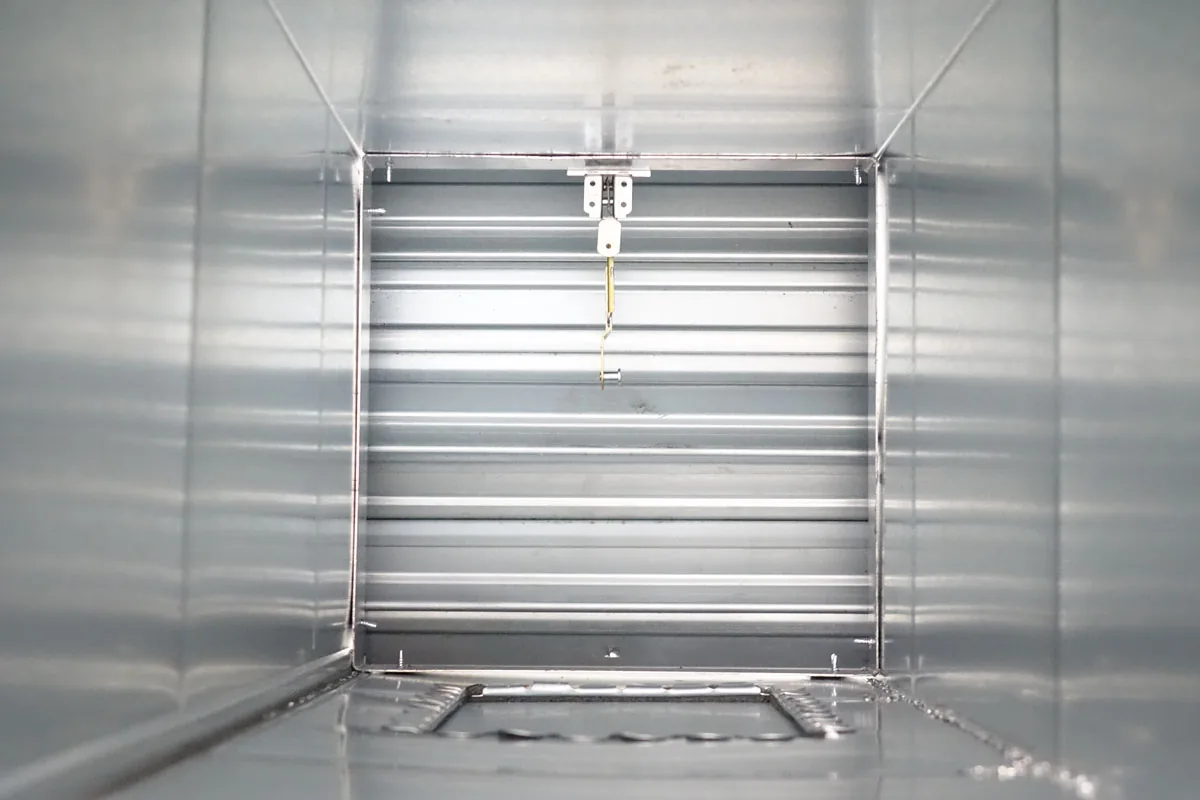
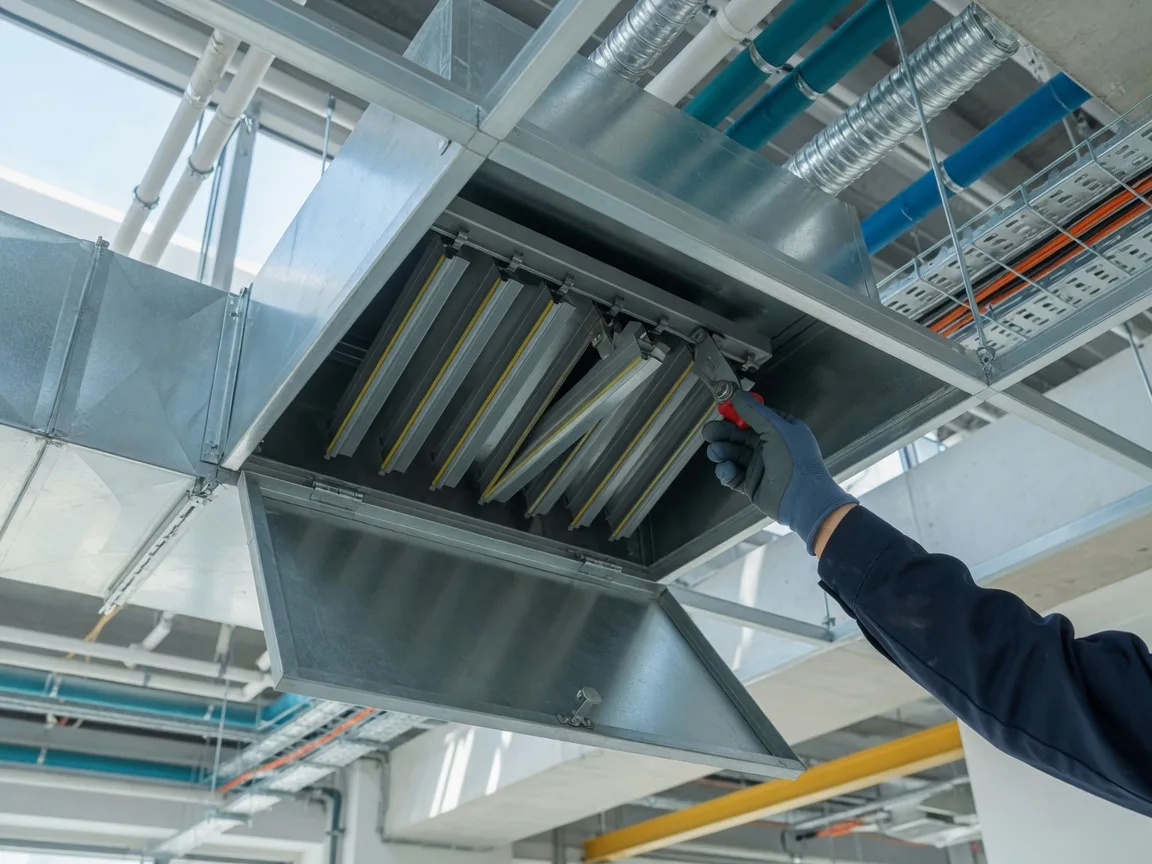
Fire damper testing, inspection and maintenance to BS 9999:2017, evidenced with drop tests and photographic reports.
Cleaned, tested and certificated to BESA TR19
Photographic evidence filed with every job
A named engineer replies within 24 hours
Request your free survey
BESA TR19 & TR19 GreaseBESCA Vent Hygiene AssociatePart of Gemini AMPM · est. 19970330 043 0080 · 24/7
Fire dampers are the metal barriers inside your building’s ventilation ductwork that close automatically in a fire, sealing the duct where it passes through a fire-rated wall, floor or compartment line. They contain fire and smoke long enough to allow safe evacuation and give firefighters time to control the blaze. Clean Ducts installs, inspects, drop tests and maintains fire dampers across every building type, with written reports and photographic evidence that demonstrate compliance.
Most of the time a fire damper does nothing at all. It sits open inside the duct, out of sight behind an access panel, letting air pass through the system as normal. That is exactly why testing matters. A damper that has quietly seized, rusted or become obstructed looks no different from one in perfect working order, and the only way to know it will close when it matters is to inspect it and drop test it. Because dampers sit at the points where ductwork crosses fire-rated walls and floors, a single failed damper can undo the compartmentation the rest of the building relies on, letting fire and smoke travel along the duct into areas that should have stayed protected.
What needs to be checked when testing a fire damper
Our engineers carry out an internal visual inspection of each damper and test its operation. That inspection covers:
Damage or obstructions to the curtain
Internal blades operating and closing fully
The spring mechanism working correctly
Channels and side rails clear of obstruction
The fusible link intact and of the correct type
Dirt, dust or contamination in the ductwork that could stop the damper closing or operating correctly in a fire
A drop test to confirm the damper closes and resets as intended
Any other faults
Every finding is recorded, with photographic evidence for each damper inspected.
Each of those checks exists for a reason. The fusible link is the component that releases the damper when temperatures rise, so a missing, damaged or incorrect link can mean the damper never triggers at all. The channels and side rails are what the curtain or blades travel through as the damper closes, and even a modest build-up of dirt or debris in them can stop the damper short of fully sealing the duct. That is why fire damper testing and ventilation and ductwork cleaning sit so closely together as services: a clean duct gives the damper a clear path to close, while a contaminated one can leave a gap for smoke and fire to pass through.
The drop test is the part of the inspection that proves the damper actually works rather than simply looking intact. The engineer releases the damper, watches it close fully under its own spring or gravity mechanism, then resets it into the open, ready position. If a damper fails its drop test, that failure is recorded, photographed and reported, so it can be repaired or replaced before it is needed in earnest.
Fire damper testing and maintenance to BS 9999:2017
Clean Ducts is the ventilation-hygiene brand of Gemini AMPM, and we test, clean and maintain fire dampers in accordance with BS 9999:2017. That means your dampers are drop tested, cleaned and maintained at least once every year, so you can show that each one has been checked and left in working order.
AMPM stands for Asset Management and Planned Maintenance, and that discipline is exactly what fire damper compliance needs: a fixed annual cycle, a record of every test, and faults dealt with rather than deferred. Testing, cleaning and maintenance are handled as one service, so a damper that fails because of contamination is not simply logged as a failure and left with you to resolve. The ductwork around it can be cleaned and the damper retested as part of the same programme of work.
If you are the designated fire prevention officer, or the person responsible for fire safety within your building, we provide a written report and photographic evidence to support your compliance records. Engineers are BESA-trained, and reports are prepared to be used as part of your building’s fire safety documentation.
What to expect from a fire damper inspection visit
A fire damper inspection follows a clear sequence. The engineer first confirms the location and quantity of dampers in your building, because dampers that nobody knows about are dampers that never get tested. Each damper is then accessed, usually through an access panel in the ductwork, and given the internal visual inspection described above. The drop test follows, whether the damper is manual or spring-loaded, and the damper is reset into its open position once it has closed correctly. Finally, everything is documented: the condition of each damper, the result of its drop test, photographs of what the engineer found, and a clear record of any faults or failures that need attention.
You receive that documentation as a written report you can file with your building’s fire safety records. If a damper cannot be accessed, has failed its test or shows damage, the report says so plainly, so you know exactly what needs to be put right and can evidence that you acted on it. And when the fix is a repair or replacement rather than a clean, the remedial work runs through our parent company Gemini AMPM’s fire division: the failure and the fix stay inside one accountable group.
Who is responsible for fire damper testing
If you are the building owner, the facility manager, the designated fire prevention officer or the person otherwise responsible for fire safety in your building, fire damper testing sits with you. Under the Regulatory Reform (Fire Safety) Order 2005, fire safety measures, dampers included, must be kept maintained in efficient working order, and you need records to show it has been done: which dampers were tested, when, what was found and what was done about any failures. That is why every Clean Ducts inspection is backed by a written report with photographic evidence for each damper, prepared so it can slot straight into your fire safety documentation.
Responsibility does not end with the annual test. If building work alters the layout of your ductwork, if compartment walls are moved, or if a damper is disturbed during other maintenance, the affected dampers should be checked again rather than left until the next scheduled visit. Keeping the testing record current is what turns a set of dampers from an unknown into evidence that your building’s fire compartmentation will perform as designed.
Fire damper FAQs
What are fire dampers?
A fire damper is a safety device installed in the ductwork of heating, ventilation and air conditioning (HVAC) systems to prevent the spread of fire and smoke through ducts in walls, floors and ceilings. It closes automatically when high heat is detected.
What is the purpose of fire dampers?
Fire dampers are designed to prevent the spread of fire and smoke through ductwork and ventilation systems. They act as barriers, closing off airflow during a fire to contain flames and smoke within a defined area.
Where are fire dampers located?
Fire dampers are typically installed in ventilation ducts that penetrate fire-rated barriers throughout a building, such as walls and floors. Their placement compartmentalises the building and is critical to delaying the progression of fire.
How does a fire damper work?
Fire dampers can be passive or motorised. Passive dampers rely on gravity and springs to close when exposed to high temperatures, forming a barrier within the ductwork. Motorised dampers use electronic actuators and are often connected to a fire alarm or building management system (BMS).
Do fire dampers require maintenance?
Yes. Regular inspection and maintenance are essential so that a damper functions correctly when it is needed. This includes checking for obstructions, verifying proper closure and addressing any issues promptly.
Maintenance also includes cleaning. Dirt and contamination inside the ductwork can build up in the damper’s channels and stop it closing fully, so keeping the surrounding duct clean is part of keeping the damper reliable.
What compliance is required for fire dampers?
Fire dampers must comply with the relevant building regulations and standards. Regular inspection and testing are required to meet those requirements, and records should be kept to evidence that the work has been carried out.
In practice, for UK buildings, that means testing to BS 9999:2017 at least once a year and holding a written record, with photographic evidence, for every damper tested.
Do fire dampers integrate with building systems?
Fire dampers form part of a building’s overall fire protection strategy. They work alongside other measures such as fire doors, sprinkler systems and smoke detectors.
Are fire dampers critical for life safety?
Properly functioning fire dampers are critical for life safety, because they limit the spread of fire and smoke and give occupants more time to evacuate. The Fire Safety Order requires them to be kept maintained in efficient working order, evidenced here with full reports and photographic evidence for each damper inspected. Building owners and facility managers should understand the fire protection requirements for their premises and ensure dampers are installed, maintained and tested to the relevant regulations.
How often should fire dampers be tested?
In the UK, fire dampers must be tested and inspected at least annually in line with BS 9999:2017. Spring-loaded (mechanical) dampers must also be drop tested to confirm proper function.
Treat annual testing as the minimum. If a damper fails a test, is disturbed by building work or sits in a heavily contaminated system, it should be dealt with sooner rather than left until the next scheduled inspection.
What is the difference between a fire damper and a smoke damper?
Fire dampers close when temperatures rise due to fire. Smoke dampers close in response to smoke detection. Some systems use combination fire and smoke dampers for dual protection.
What happens during a fire damper test?
An engineer will:
Inspect the damper access and condition
Perform a drop test, whether manual or spring-loaded
Reset the damper
Document and report any issues or failures
What are common issues found with fire dampers?
Blocked or inaccessible access panels
Damaged blades or fusible links
Dampers painted shut or rusted in place
Missing compliance documentation
None of these faults announce themselves in day-to-day use. A damper that is painted shut or rusted open passes air exactly as a healthy one does, and missing documentation only becomes visible when someone asks for the records. Regular testing surfaces these issues while they are still straightforward to fix, and the photographic report gives you the paper trail to show they were dealt with.
Can fire dampers be retrofitted into an existing building?
Yes. Fire dampers can be retrofitted, but it requires careful planning to keep the installation compliant with fire compartmentation rules and the HVAC design.
Clean Ducts installs fire dampers as well as testing them, so retrofit work can be surveyed, installed and then brought into the same annual testing cycle as the rest of your building.
How can I find out if my building’s fire dampers are compliant?
A professional fire damper inspection will check the location and quantity of dampers, compliance with the relevant standards such as BS 9999, and your testing and maintenance records.
To confirm the condition of the fire dampers in your building, or to arrange annual testing with a full written report, request a survey and we will take it from there.