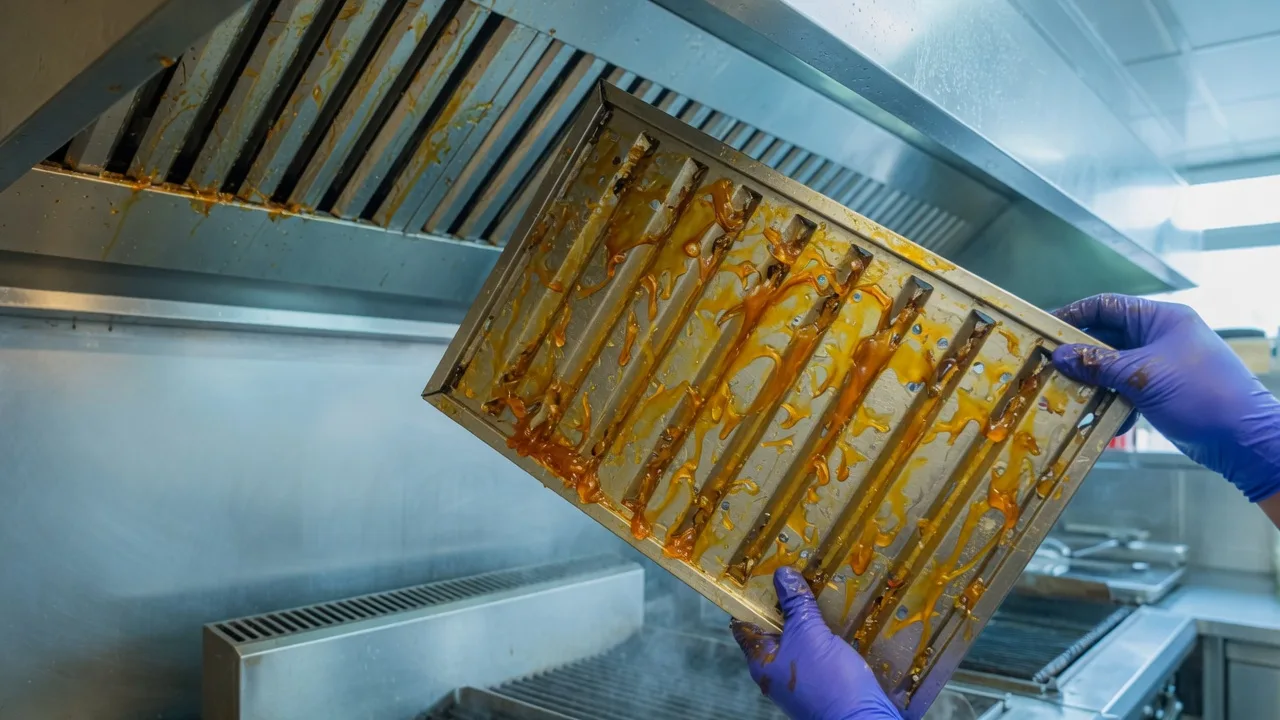
A commercial kitchen fire reaching the news is a reminder that these events keep happening across the UK when kitchen extract systems fail. Grease accumulation, poorly maintained fans and electrical equipment, and a lack of regular TR19-compliant cleaning all contribute to fire risk in ways many operators underestimate.
Whether a fire starts in the canopy, the fan unit, or in the ductwork itself, the outcome tends to be the same: once grease ignites, the extraction system can act like a chimney, spreading flame and smoke far beyond the kitchen. That is why a scheduled cleaning and maintenance programme matters. Removing the build-up of grease across the ductwork, canopy and fan is what limits both the spread and the intensity of a fire.
Why grease build-up and poor maintenance are dangerous
Kitchen extract systems are designed to carry hot air, grease vapour and steam away from your cooking equipment. But fat, oil and grease (FOG) do not simply disappear. They condense inside the canopy, risers, ductwork and fan housing, creating highly flammable deposits that feed a fire once it starts.
Left unattended:
- Grease becomes the fuel source for a fire that can spread in seconds.
- The ductwork becomes an unintended channel for flame and smoke to travel, endangering staff, customers, and neighbouring businesses or residents.
- Fans and electrical components coated in grease are more prone to overheating, electrical faults and failure, which raises the risk of ignition further.
The crucial role of TR19 Grease cleaning
BESA TR19 Grease is the industry-recognised standard for kitchen extract and ductwork cleaning in the UK. It sets out how often systems should be inspected and cleaned, and what levels of grease are acceptable before cleaning must take place.
A TR19 Grease-compliant regime:
- Uses professional inspection methods to measure grease build-up at key points along the system.
- Ensures cleaning goes beyond superficial wiping to remove grease from inside the ductwork, canopy, fan and risers.
- Includes detailed post-clean reporting, giving you documented proof of hygiene and safety for insurers and fire risk assessors.
Working to TR19 Grease does more than reduce fire risk. It also helps maintain efficient airflow, prolongs the life of your equipment, and supports compliance with fire safety legislation and the terms of your insurance.
Fans and electrical systems matter too
Grease does not only accumulate in rigid ductwork. It also builds up in the extract fan, the motor housings and the electrical enclosures, where heat and grease become a dangerous combination.
Regular maintenance and testing of electrical components helps prevent:
- Overheating of motors and wiring.
- Short circuits caused by grease, dust and debris.
- Fan failures that reduce extraction efficiency and create back-pressure.
A clean fan and a well-maintained electrical system are as critical to fire prevention as clean ductwork.
What you can do now
- Treat any commercial kitchen fire in the news as a prompt to review your own system, and share the risk with your team.
- Arrange a TR19 Grease assessment from an accredited vent-hygiene contractor to plan an appropriate cleaning frequency.
- Schedule regular maintenance for fans, motors and electrical systems as part of your preventative regime.
- Keep accurate records of all inspections, cleaning and repairs. These are invaluable for fire risk assessments and insurance compliance.
Fire risk from grease is real and ongoing. If you are responsible for a commercial kitchen extract system, a survey is the fastest way to understand where grease is building up and how often it needs to be removed. Request a TR19 Grease survey and we will assess your system and set out a cleaning schedule that keeps you compliant.